

Before there were magnetic packs of Mascotte, before there were holographic Vibes boxes, and definitely before there were 7-Elevens on every corner, the people of Thailand were already master rollers.
We tend to think of “rolling culture” as something that exploded recently with the legal cannabis wave, but the truth is, Thailand has been rolling for centuries. The only difference? They didn’t have rice paper factories or gum lines made of acacia sap. They had the jungle.
If you think rolling with an ultra-thin RAW Black is tricky, imagine trying to roll a perfect cone using a dried palm leaf while sitting on a boat in the middle of a river. That was the daily reality for our ancestors.
These natural wraps weren’t just a “backup plan”, they were the standard. They defined the flavor, the burn, and the ritual of smoking in the Kingdom. And in a way, the modern movement towards unbleached, organic papers (like Smoking Brown) is just us trying to get back to these natural roots.
Let’s take a trip back in time. Here are the 5 legendary natural wraps that started the rolling culture in Thailand, and what they can teach us about our sessions today.
1. The “Bai Jaak” (Nipa Palm)
If you travel to the southern provinces or the coastal areas of Thailand, you will still see this today. The Bai Jaak (leaf of the Nipa Palm) is the absolute OG of Thai rolling.
The History: Long before paper was imported, locals would harvest the long leaves of the Nipa palm that grows in the mangrove forests. They would dry them in the sun until they turned a light tan color, strip out the hard spine, and cut them into cigarette-sized rectangles.
The Experience: Rolling with Bai Jaak is an art form. The leaf has a natural curve and a distinct texture, it’s ribbed, sturdy, and slightly waterproof. It doesn’t have gum, so the “seal” is created by a clever fold-and-tuck technique (or a little dab of honey if you were fancy).
The Modern Equivalent: The Bai Jaak is famous for its slow, cool burn. It doesn’t catch fire like dry paper; it smolders. If you love that robust, slow-burning feel, you are a Vibes Hemp smoker at heart. Just like the palm leaf, hemp papers offer that structural integrity and earthy vibe that feels like you are holding something substantial, not just air.
2. The Banana Leaf
Thailand is the land of bananas. We eat them, we use the leaves as plates, we wrap desserts in them, and yes, we used to smoke with them.
The History: In rural farming communities, you used what you had. Banana leaves (specifically the young, thin leaves known as Bai Tong On) were dried and cured to create a smooth, pliable wrap. This was the “everyman’s” wrap, cheap, abundant, and biodegradable.
The Experience: A banana leaf roll is smooth but heavy. It has a distinct “green” flavor that pairs surprisingly well with strong tobacco or herbs. The texture is waxy, which makes it tricky to light, but once it gets going, it burns forever.
The Modern Equivalent: Today, we don’t need to raid a banana tree to get that organic experience. RAW Organic Hemp papers are the spiritual successor to the banana leaf. They are unrefined, free from chalk or dyes, and give you that “plant-on-plant” smoking experience. You get the clean, natural connection without the harsh chlorophyll taste of a raw leaf.
3. The Lotus Petal
This is the one that surprises most people. We usually think of the Lotus as a flower for the temple or for Miang Kham (the tasty leaf-wrapped snack). But historically, dried lotus petals were the luxury wrap of the elite.
The History: Because lotus petals are delicate and fragrant, they were used by nobility or for special occasions. The petals would be dried flat, turning into a paper-thin, purple-brown sheet.
The Experience: Unlike the hearty Palm or Banana leaf, the Lotus petal is incredibly thin and fragile. It adds a subtle floral aroma to the smoke, acting like an ancient terpene infusion. It required incredibly delicate hands to roll, one wrong move and the dry petal would crumble to dust.
The Modern Equivalent: Does “fragile, ultra-thin, and premium” sound familiar? The Lotus petal was the ancestor of Smoking Thinnest or RAW Ethereal. It was for the connoisseur who wanted the absolute minimum barrier between them and the flavor. If you are the type of person who buys the thinnest paper possible to taste your terpenes, you would have been a Lotus smoker in the 1800s.
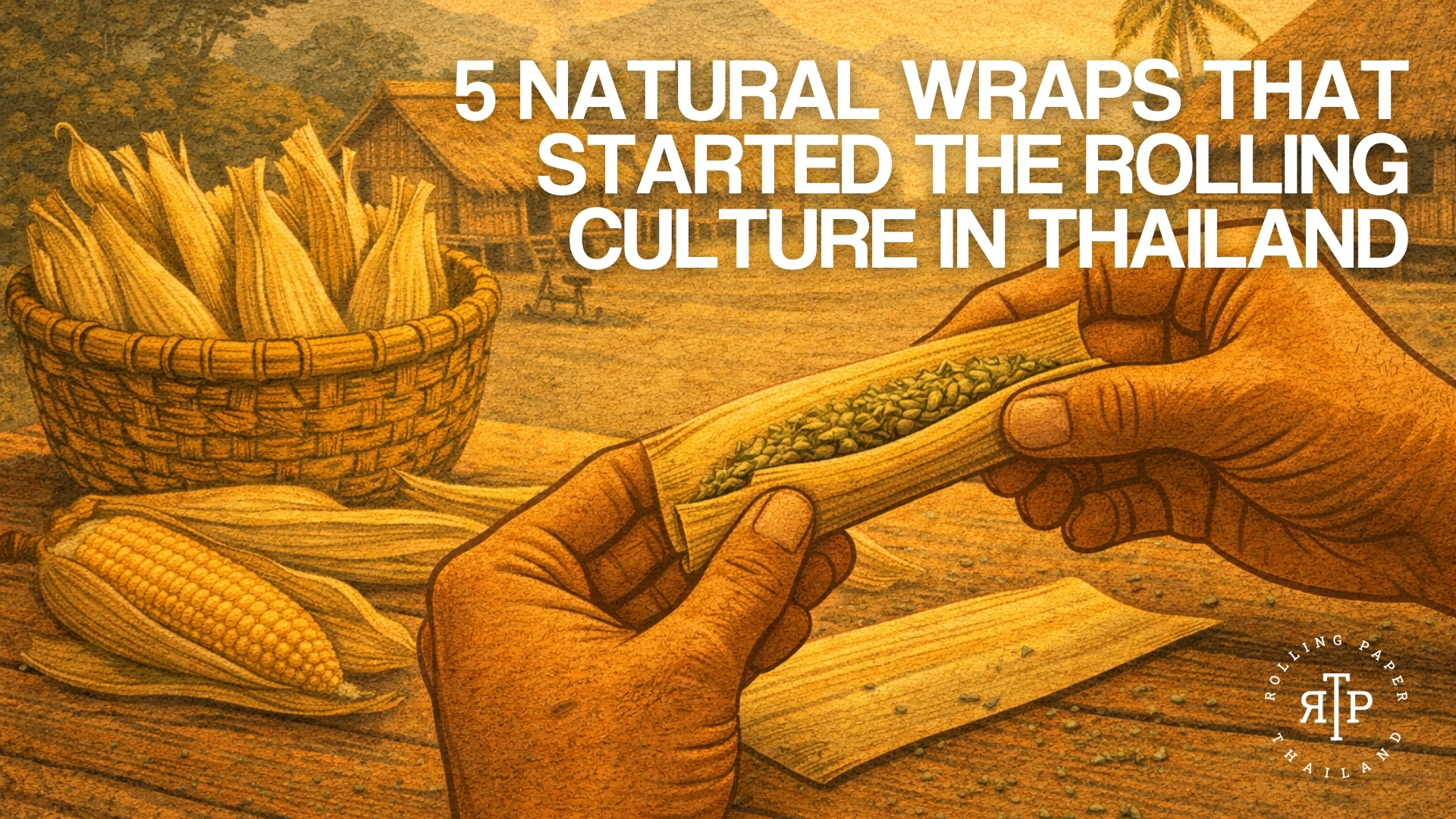
4. The Corn Husk
If you head up North to the mountains or the corn-growing regions, you’ll find the Klee Yaa (corn husk wrap).
The History: Similar to the “Corn Cob Pipe” in the West, Thai farmers utilized the dried husk of the corn. The inner layers of the husk are surprisingly soft, thin, and translucent when dried properly.
The Experience: Corn husk is sweet. When you burn it, it imparts a very mild, sugary flavor to the smoke (think of it like a natural flavor infusion). It’s also incredibly durable. You could toss a corn husk roll in your pocket, walk through a rice field, and it would still be intact.
The Modern Equivalent: The sweetness and durability of corn husk remind us of the modern Mascotte experience, specifically their original line. Mascotte papers are known for their strength and reliability. They aren’t going to tear on you, and they deliver a consistent session every time. Plus, with the magnetic pack, they are just as durable in your pocket as those old corn husks were.
5. The Cannabis Fan Leaf
We can’t talk about Rolling paper in Thailand without mentioning the legend itself, The Thai Stick.
The History: This wasn’t just a wrap; it was a method. Long before “Blunts” became a thing in America, Thais were wrapping cannabis in cannabis. The buds were skewered on a bamboo stick, wrapped in hemp fiber, and then the final layer was often a cured cannabis fan leaf, sealed with oil or sugar water.
The Experience: This is the ultimate “full spectrum” smoke. You are smoking the flower wrapped in the leaf of the same plant. It burns incredibly slow, like a cigar, and hits with heavy, intense potency. It was the export that made Thailand famous in the 70s.
The Modern Equivalent: The Thai Stick is the grandfather of the modern Cannagar or the Hemp Blunt Wrap. Brands like Royal Blunts or even the Vibes cones are trying to replicate this “heavy,” slow-burning luxury. While true Thai Sticks are a rare craft today, you can get close to the vibe by using a heavy-weight hemp paper and packing it tight.
What We Can Learn From The Past
Looking back at these natural wraps, you realize something cool: The goal has always been the same.
Even when it was a farmer using a Nipa palm leaf or a royal using a Lotus petal, Thai smokers have always chased two things:
- A Natural Burn: No chemicals, no bleach, just plant matter.
- The Ritual: The skill required to roll these delicate leaves was high. It was a craft.
Today, we have it easy. We can walk into a shop and buy a pack of RAW or Mascotte that is perfectly cut, gummed, and ready to go. We don’t have to dry our own leaves in the sun for three days.
But the spirit remains. When you choose an unbleached, organic paper over a bleached white one, you are nodding to that history. You are choosing the natural path, just like the locals did hundreds of years ago.
Want to keep the tradition alive? You might not find dried Lotus petals at our shop (yet!), but you can find the next best thing. Check out our collection of Natural & Unbleached rolling papers at Rolling Paper Thailand. From the earthy vibes of RAW Organic to the precision of Mascotte Brown, we have everything you need to keep your session authentic.